We were planning to be in Copenhagen around this time but Rob noticed something on social media a few months before we left Australia. It was a video about a Masterclass with uplifting testimonials from previous participants.
This related nicely with my work in Canberra in the sustainable development of our new suburbs and urban spaces and we were able to plan our trip to fit it in. This blog is specifically on the Masterclass which ran from 25-27 June 2018 , and some observations from other cities we’re visited, and to draw out some possible lessons for home.
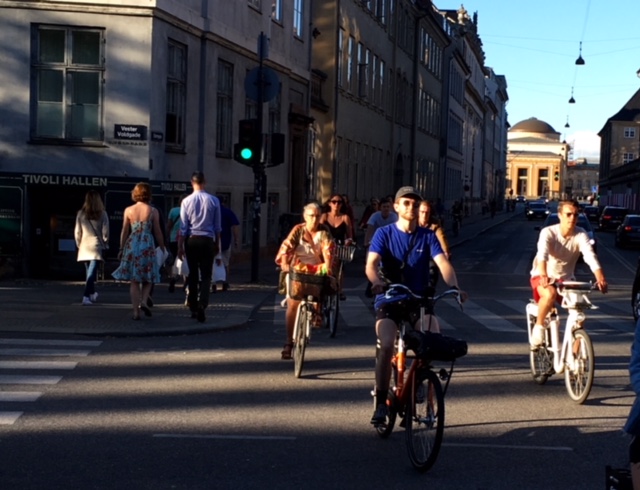
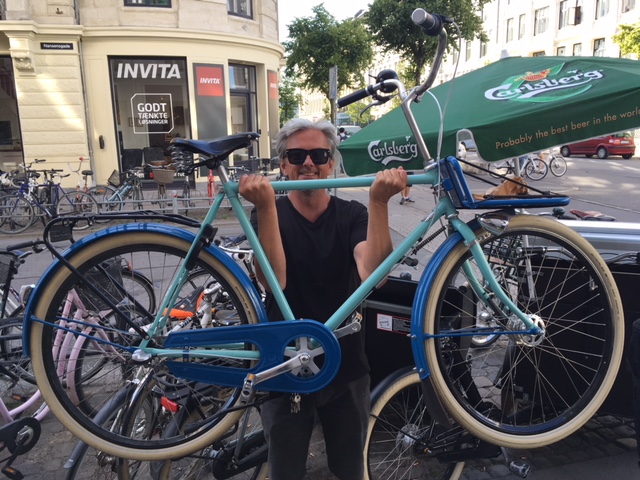
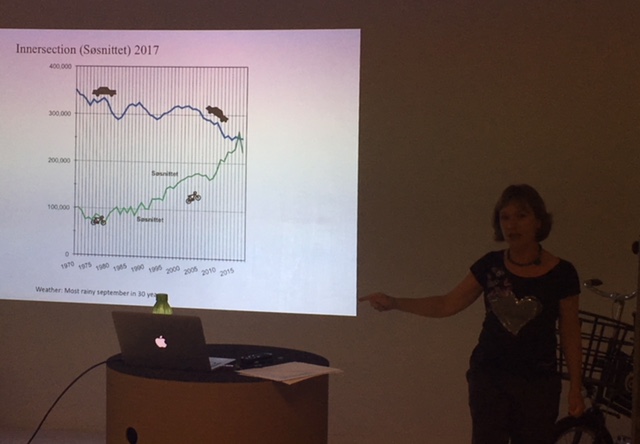
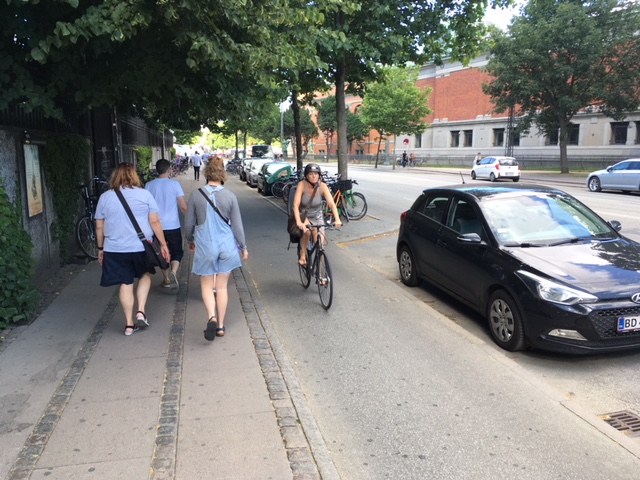
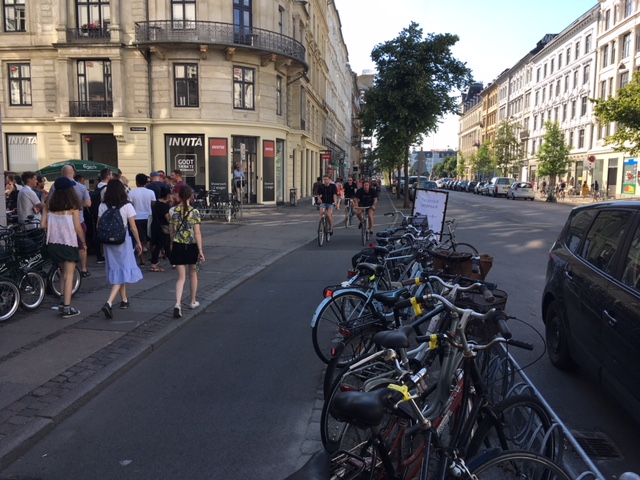
Cycling in Copenhagen, people get around in everyday clothes, on any old bike and most people choose not to wear a helmet because cycling feels safe. More trips are now made by bicycle and than by car.
Copenhagenize design company
The Masterclass was run by Copenhagenize, who specialise in working with cities to improve their bicycle infrastructure. They are Copenhagen-based and draw on lessons from Copenhagen, but also now have offices in Barcelona, Montreal, and Brussels.
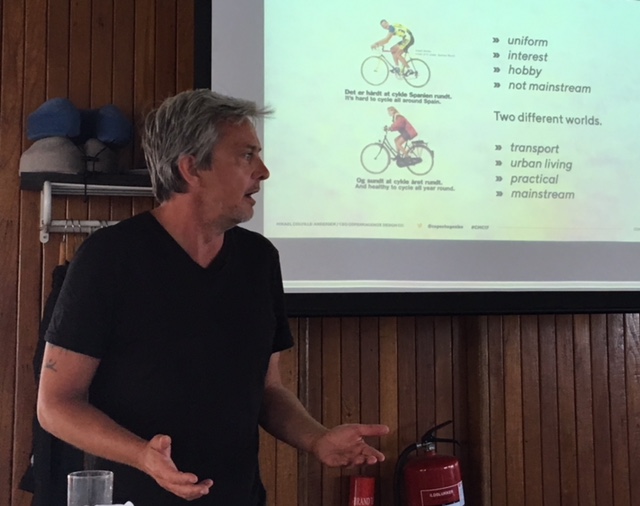
Mikael Colville-Anderson who started the Copenhagenize design company. I’d describe him as charismatic and purposefully provocative
One of the key lessons from Copenhagen is that everybody cycles – not just people in lycra and most people choose not to wear helmets. It feels so mainstream, the infrastructure is good and people feels safe.
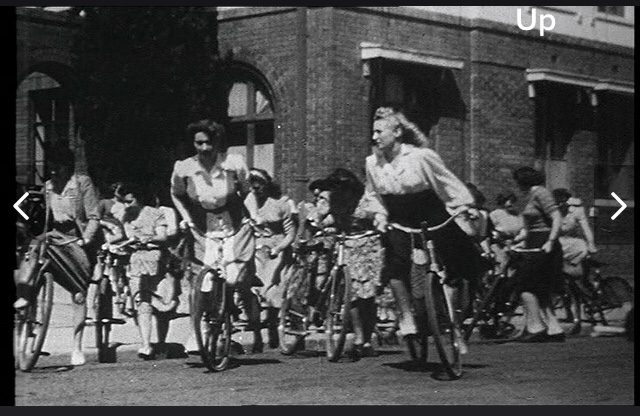
Most cities have always had cycling. Mikael provided this one from the archives from Canberra in 1950 showing office workers heading out from work for the lunch break
The most impressive thing about cycling in Copenhagen, apart from the infrastructure, is the behaviour. That includes the motorists, the cyclists and the pedestrians.
This is probably one of the great challenges for Australia, where in some cities particularly there is open hostility to cyclists. In Copenhagen you get the feeling that every driver is also a bike rider and shows that level of respect.
The workshop
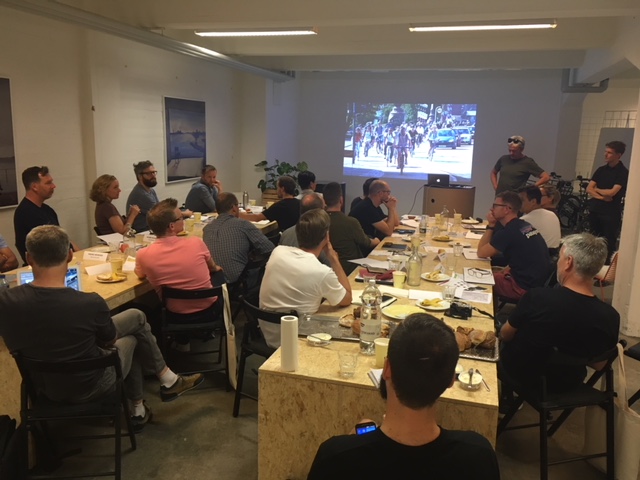
Greeted by the coffee bike on the first morning at the Copenhagenize offices. They’re part of an energy hub in the urban development area of NordhavnThe group included transport planners, developers, activists and consultants. People came from all over the world including from New York and Charlotte in the USA, Santa Fe in Argentina, Stockholm, Zurich, Manchester, Cardiff, Norway, Adelaide, Perth and Canberra. The Copenhagenize Team had also come together from Barcelona, Montreal, Brussels and Copenhagen.Ase from the Copenhagen City Council gave us an overview of how they use observations and data to inform policy. More than half the trips in Copenhagen are now made by bike
Some history
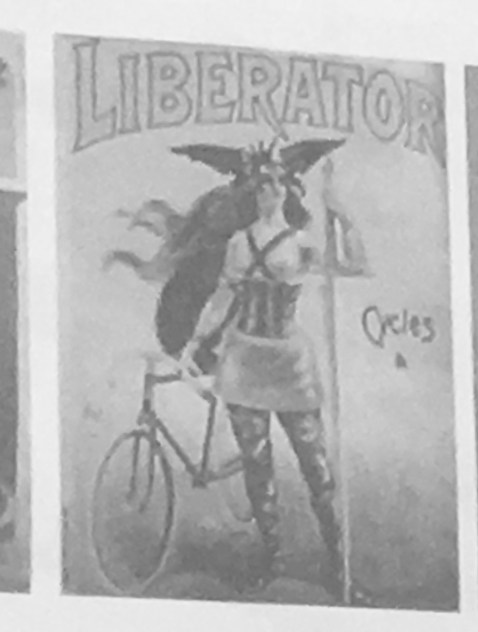
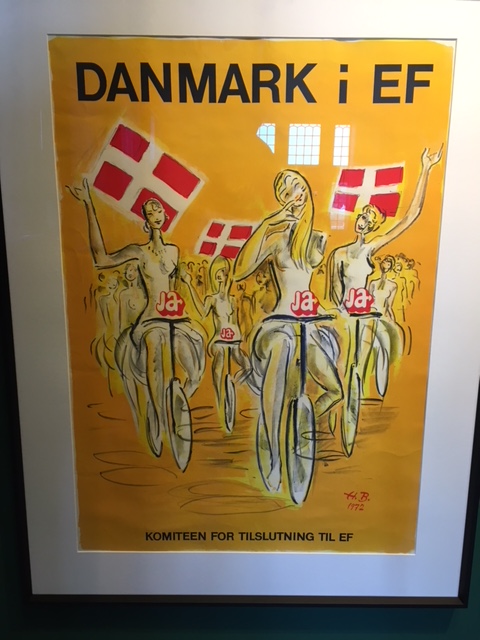
From the late 1800s the future of the bike was bright. It transformed more that any other innovation and was promoted as liberting women and the working classThe power of marketing. Bicycles used in a poster from the early 70’s to support the Yes campaign to join the EU. Positive, youthful, looking the future, with women leading the way. Just imagine being greeted at the Canberra airport with images promoting cycling and Canberra, rather than military hardwareMikael presenting a session on communicating bicycle urbanism. It should be seen as something that is practical and a mainstream part of urban living, not as an exclusive activity with expensive equipment
In over 100 years, little is new, with the exception of bike share.
The key is to have a network of dedicated trails that are connected and safe. Nothing new needs to be invented, it’s a matter of sharing knowledge from what has already been done in other cites, really just a matter of cutting and pasting.
Of course specific solutions will be required in some circumstances, depending on availability of space.
While the ideal Copenhagen standard width of a cycles lane is 2.3m as cycling becomes more popular, and with the increase in cargo bikes this may need to be expanded, for example to 3m.
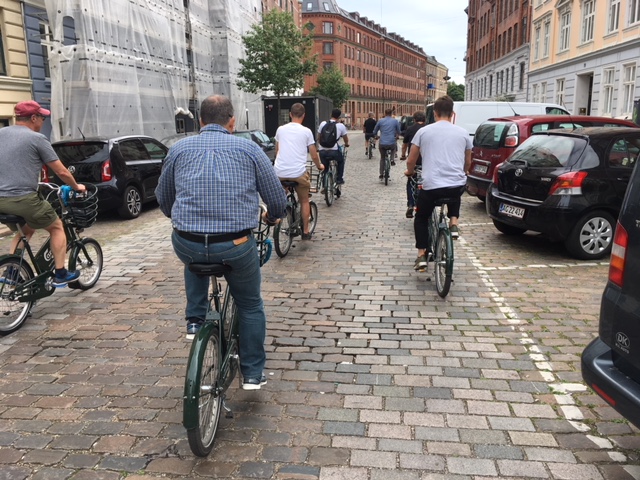
We spent lots of time over the three days actually riding around the city looking at things that worked, some things that hadn’t worked so well and others that still needed work.
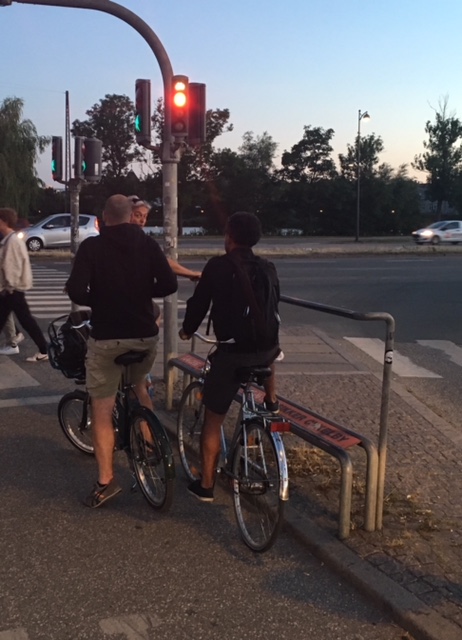
We learned that it’s not just about the infrastructure. In Copenhagen cyclists are made to feel special. Little things like rails at intersections for cyclists to lean on with a sign to thank you for cycling
The little things – rails to hold on to and foot rest while waiting at the lights with encouraging messages thanking people for riding
There is a bicycle doctor, when a bike is parked in the wrong spot, obstructing access, they will move the bike, oil the chain, pump the tyres and leave a note of explanation.
There are also opportunities for social enterprises like Pop up bike repair shops. In Oslo there is a program to engage refugee kids.
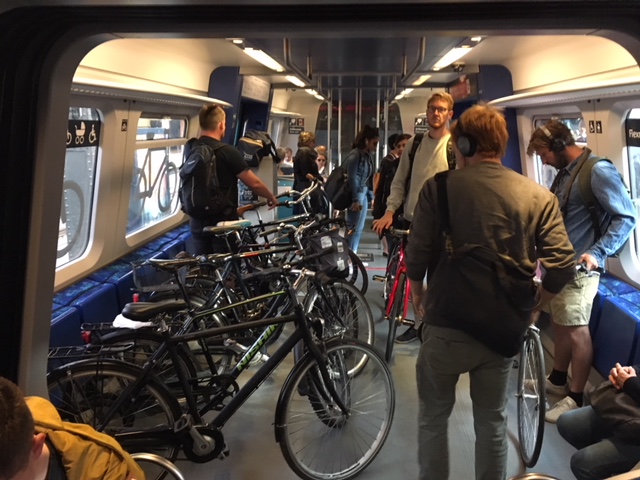
Make things comfortable for cyclists. many European cities have cobble stones which are a bit rough to ride on. Here in Copenhagen, the two lighter coloured strips on the road have been relaid to provide a smother riding surface.Make it easy for cyclists to use public transport. Certain parts of the trains are made available to bikes. However as cycling becomes even more popular, and bike sharing is also expanding, there are initiatives to link public transport ticketing with bike share to avoid taking up so much space on public transport.
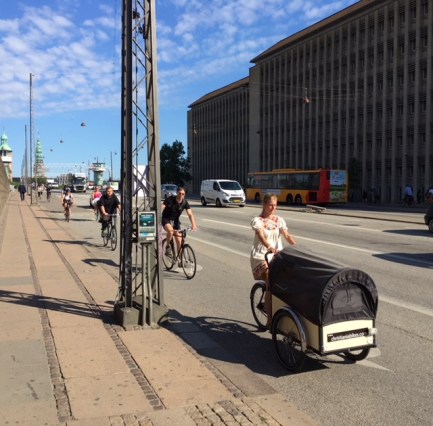
Cargo bikes are big.
They’re used for everything from moving kids, work gear, goods around the city. There’s coffee bikes and even a mobile restaurant.
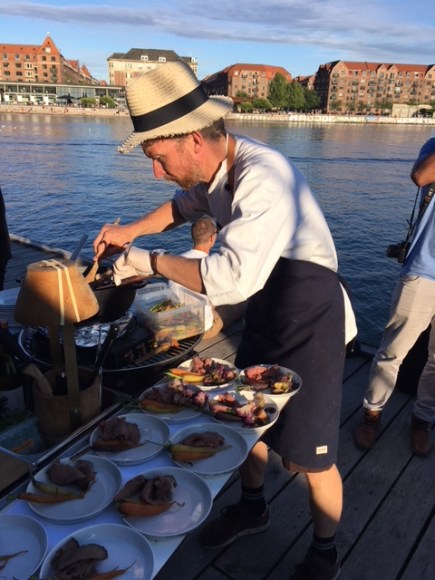
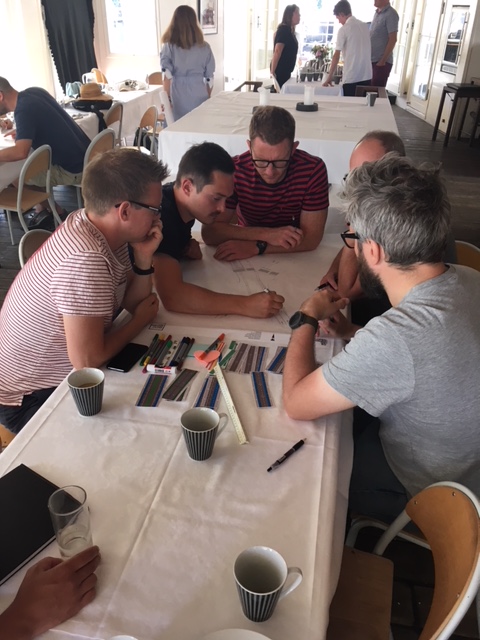
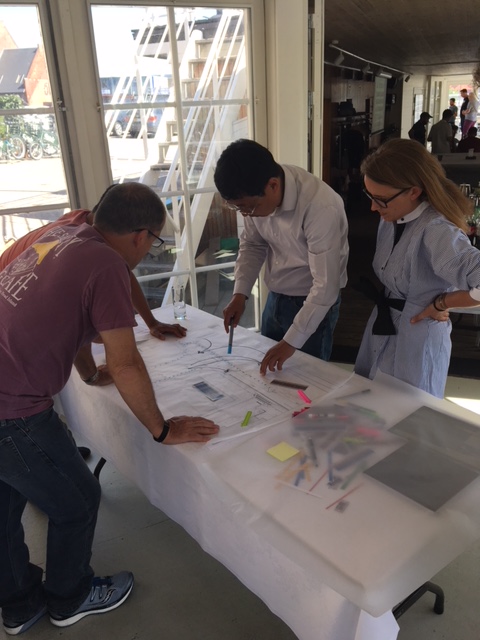
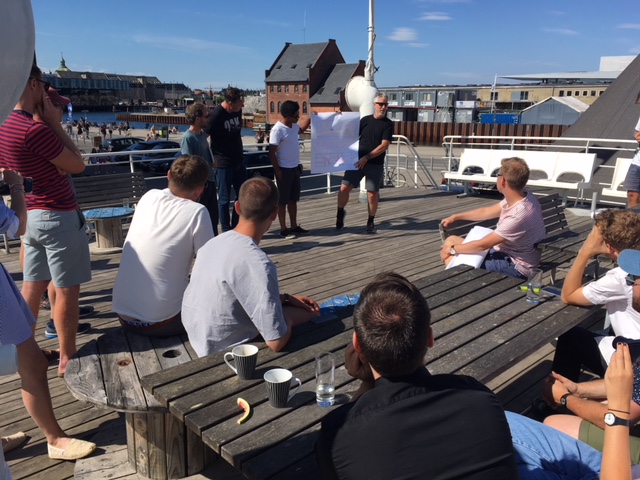
Cargo bikes move everything from kids to musical instrumentsRoyal Price Frederick is a good role modelThe bike chef provided us with a gourmet dinner on the harbour at the end of day 1. He cycles his mobile restaurant around complete with everything needed for cooking and coolingThe last day of the Masterclass was held on a former ferry on the harbour where we broke into workshop sessionsGroup workshops to resolve selected real world challenges that participants had brought from their cities
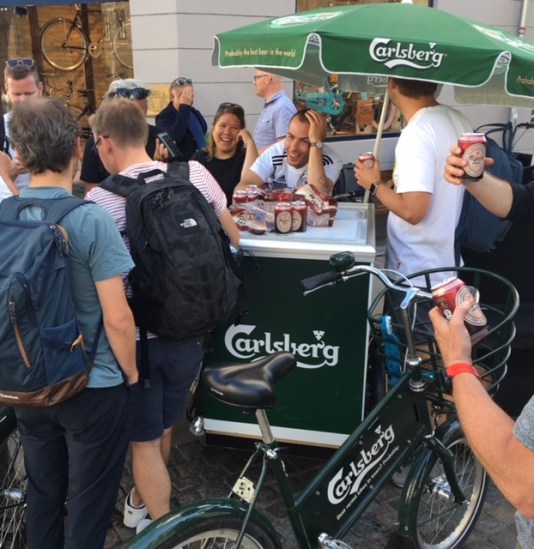
Final group presentationsReturning the hire bikes at the end of the workshop. World Cup Fever around the bicycle beer cart
Lessons from the workshop for infrastructure in Canberra
Depending on the hierarchy of roads there are four types of bike ways:
Shared space in low speed environments
The painted line
Kerb separted
Off Street particularly in higher speed environments
Shared space
This involves things like speed humps and traffic calming measures to slow vehicles down but allows cyclists to travel smoothly. Ideal in local streets. In narrow streets car parking could be removed on one side of the street to allow more space for cyclists on dedicated routes.
Shared roads where car speeds a kept low
Painted line.
This is a quick and cheap option used in many cites, but depending on how it is done can lead to a number of problems. A bike path that is defined only by a painted line can be impacted by traffic and they do get parked in. Bus stops can also be a source of friction.
If the painted bike lane is between parked cars and moving traffic the cyclist is at risk of car doors being opened.
Cyclists should be viewed as fast moving pedestrians, not as cars. Cyclists should be on the pedestrian side of parked cars.
Not such good examples:
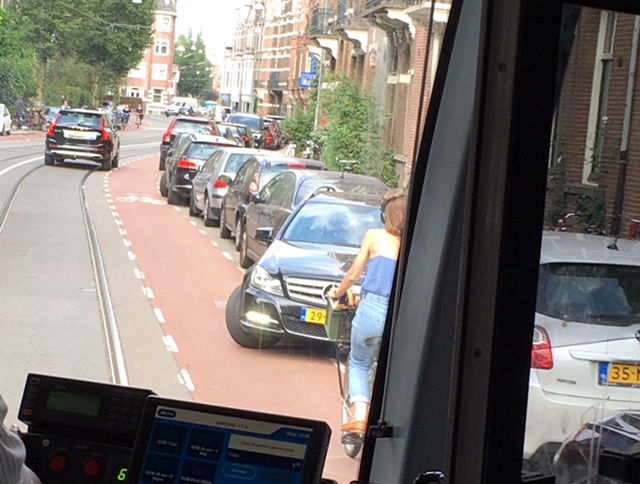
Although Amsterdam also has a lot of cyclists, there are many not good examples there. This view from a fast moving tram shows a painted bike lane, but it is on the traffic side of parked cars.
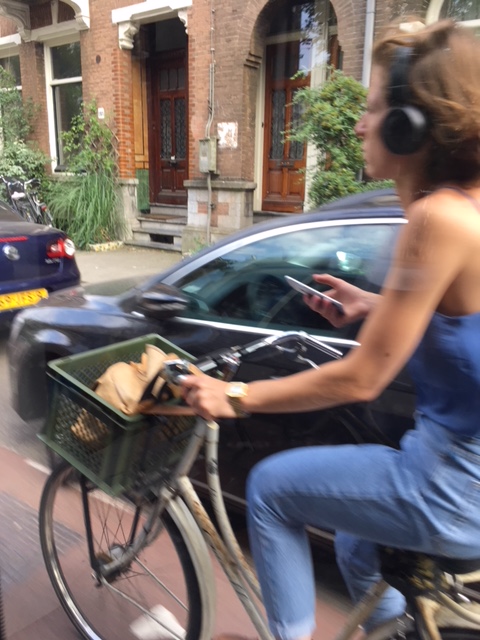
View from a fast moving tram. The cyclist has to contend with parking cars, car doors opening as well as fast moving vehicles.Safety not improved by texting and wearing headphones
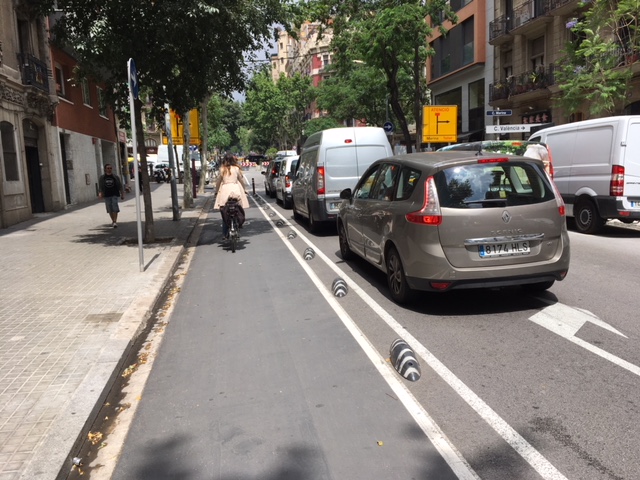
Painted bike lanes can be made safer by using modular bollards.
In Barcelona, painted lines are reinforced with bollards to discourage cars from parking or driving in the bike lane, increasing the feeling of safety for the cyclist.
Kerb separated.
The the gold standard applied in Copenhagen is a 2.3 m bike path is stepped up from the road, and the footpath is stepped up again from the bike path. If possible the bike path should be a different colour to make it clear to everyone.
The “gold standard Copenhagen bike path”. The bike lane is adjacent to the footpath, it is unidirectional, running in the same direction as the traffic, but separated from the traffic. The bike path is set lower than the footpath and higher than the road to reinforce the separation and improve safety.The Copenhagen bike path. Separation from the traffic can be increased with landscaping, bike parking or parked cars
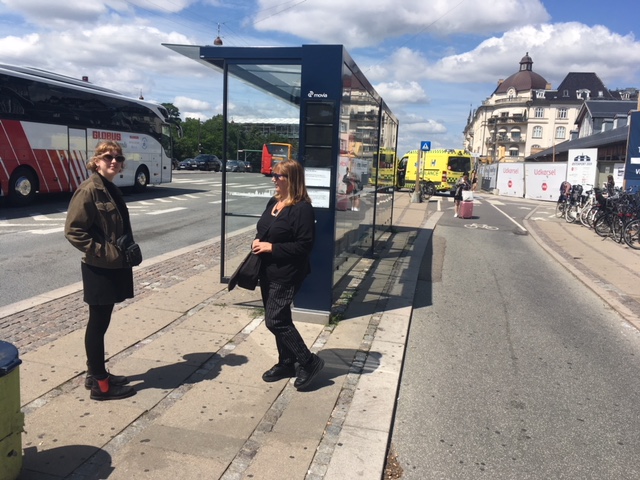
Kerb separated Copenhagen bike way, well out of the way on the bus stop. Note the unsuspecting tourist on the bikepath in the background trying to work out directions. You learn very quickly not to stand on the bike path
Intersections – networks are only as strong as the weakest link and intersections are the weakest link.
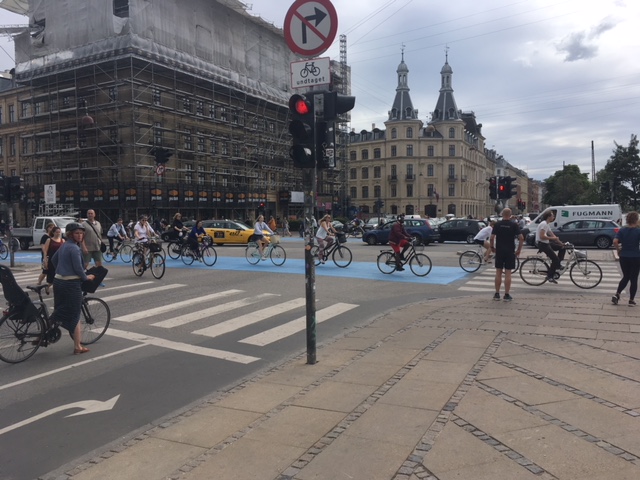
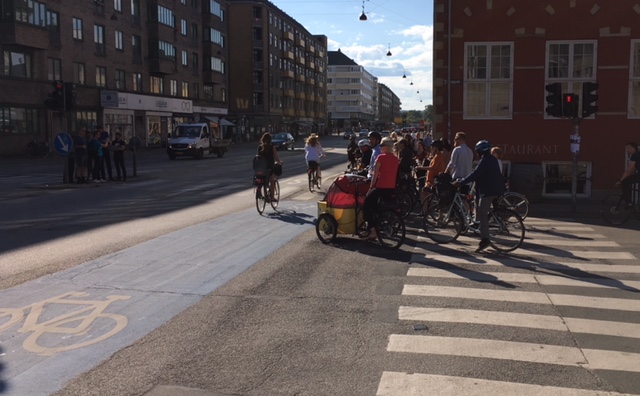
Bike lane highlighted in blue across the intersection to make things clearer for cyclists, pedestrians and motorists. Research has shown that the highlighting can become less clear if it is used too much. For greater clarity the highlighted bike lanes are only used here in the main direction of traffic
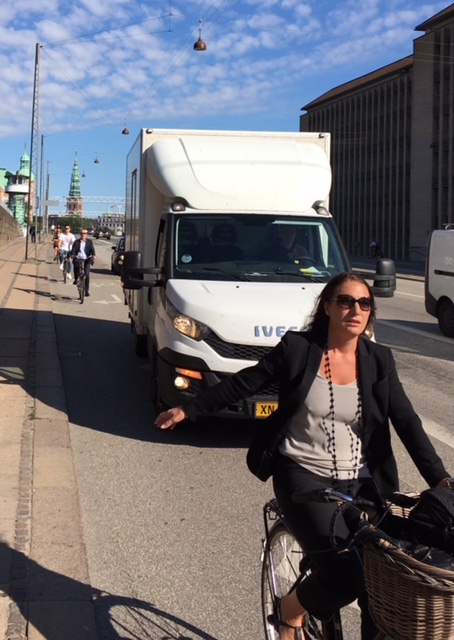
At right hand turns (left in Australia) there is a mixing zone. Cyclists all give clear signals and drivers give way to cyclists. This is also assisted by traffic signals which give cyclists a head start. Drivers need to undertake bicycle awareness as part of the process of getting a licence, and kids learn about bicycle safety and using the correct signals as a key part of their educationIn Australia the more confident cyclists turning right at a major intersection will mix it with the traffic in the right hand turning lane (that is equivalent with turning left in Copenhagen) which can be intimidating for less confident cyclists. In Copenhagen, all cyclists will signal clearly, exit the cycle way to the right, swing around avoiding pedestrians, and wait for the signals to change before proceeding strait ahead. This requires adequate space for the number of cyclists, as well as for pedestrians to cross. This means the cars are set back slightly.
Some examples from other cities:
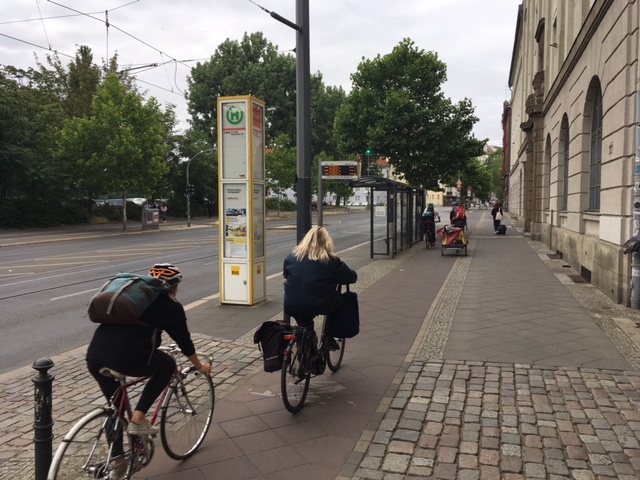
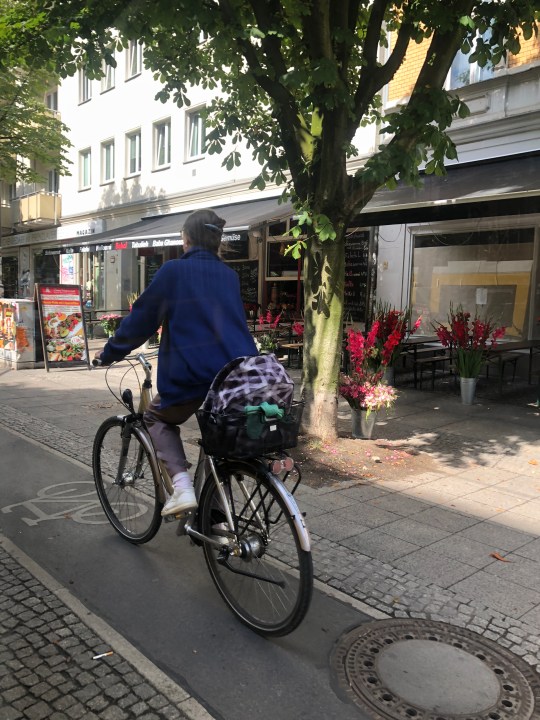
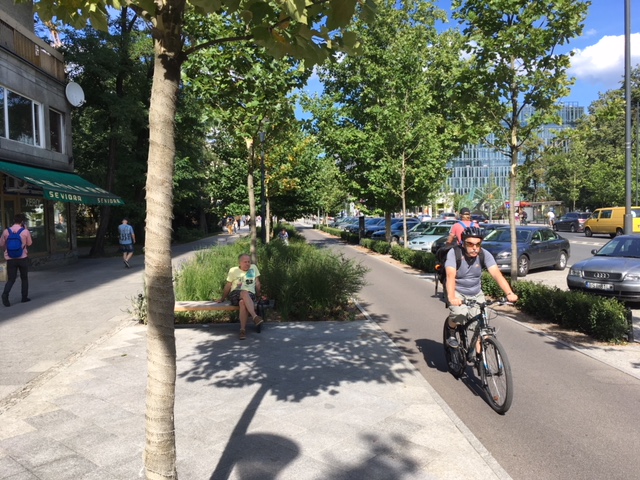
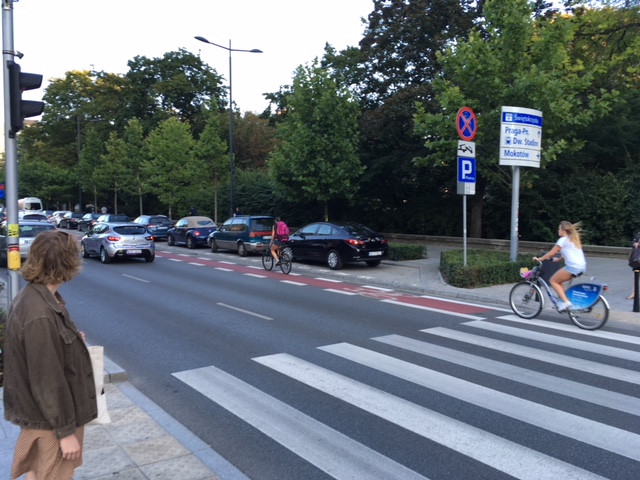
Uni directional bike lane in Berlin. Good example of keeping the bike path behind a bus or tram stop to avoid conflict with the vehicles and the passengers as they get on and off.Another example of a unidirectional path in Berlin. Although it is differentiated by the paving treatment, the bike path is a bit narrow, not the ideal 2.3m, and is not grade separated, leading to some confusion and conflict between cyclists and pedestriansGreat example in Warsaw of integrating landscaping with a separated bike way
However on the other side of the road, a less than optimal painted lane between parked cars and the traffic
Off street bidirectional
Uni directional bike paths on either side of the road are preferable and should ideally be installed consistently throughout the network. They result in less conflict and much better behaviour at intersections.
There are however cases when bidirectional bike paths are appropriate, for example through extensive open space areas or between towns, and along rivers or railway lines where intersections are likely to be minimal.
With bidirectional bike paths it is always important to keep bikes and pedestrians separated and have a pedestrian path.
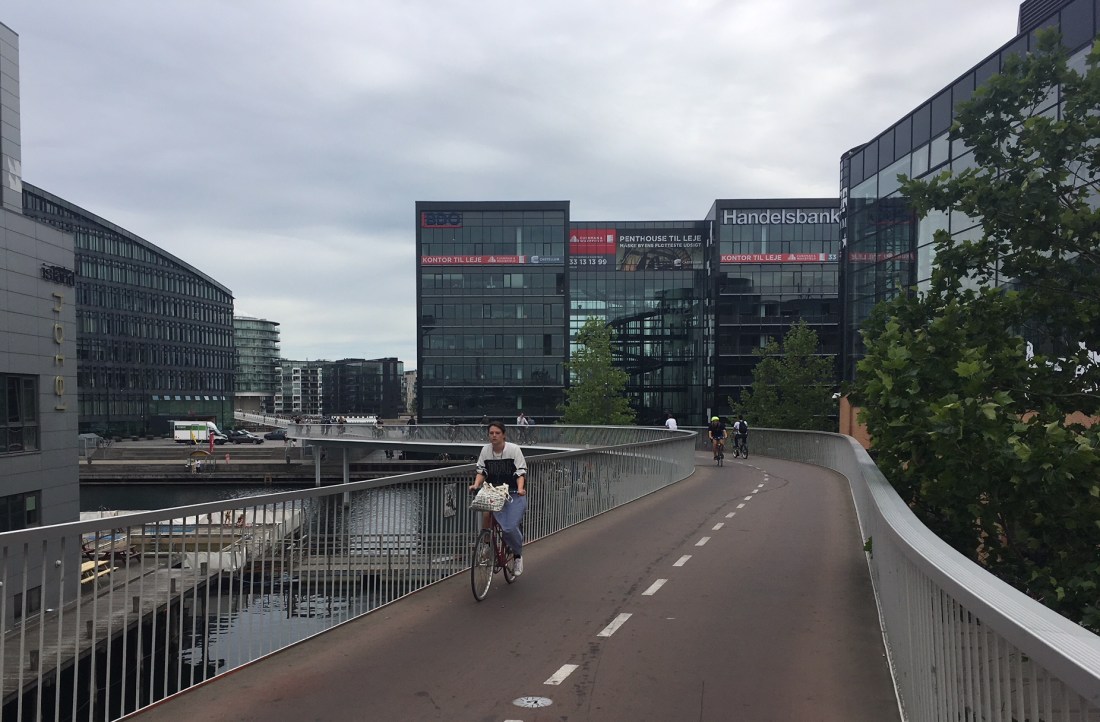
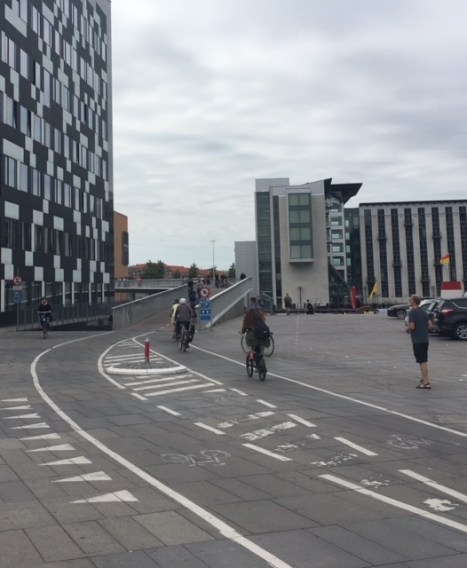
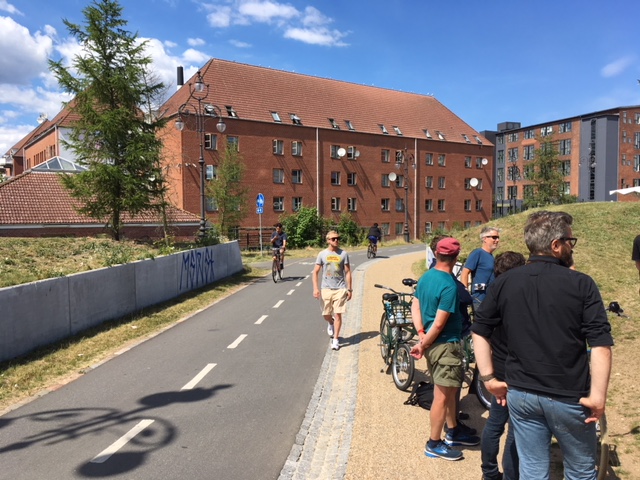
The bicycle snake in Copenhagen provided a much needed bicycle only link between a key harbour crossing and other parts of the city. In this case there are alternative routes for pedestrians.The snake is now so popular and fast, that a pedestrian island is required for safe crossing“The Kissing Bridge” a new bridge crossing for cyclists and pedestrians (separate path in grey)
Although bidirectional paths are not favored, they can be used successfully through open space areas, or along rivers or railway lines. It’s important to also provide a clearly differentiated pedestrian path. In this case partly occupied by the Masterclass on site tour.
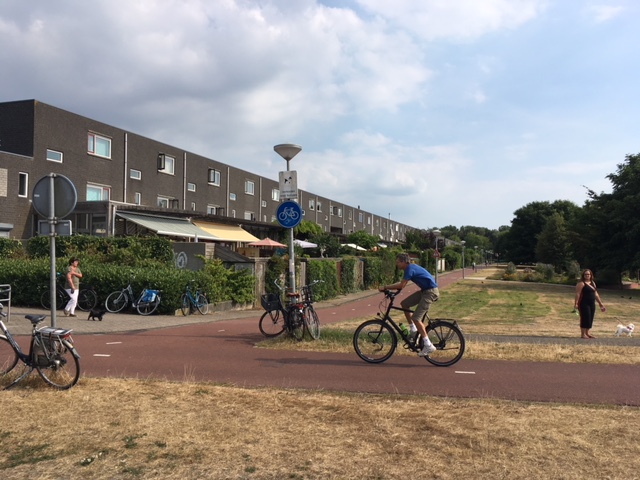
Bidirectional bikeways in outer areas of Amsterdam. While appropriate in some situations bidirectional paths are poor for intersection behavior
Traffic signals.
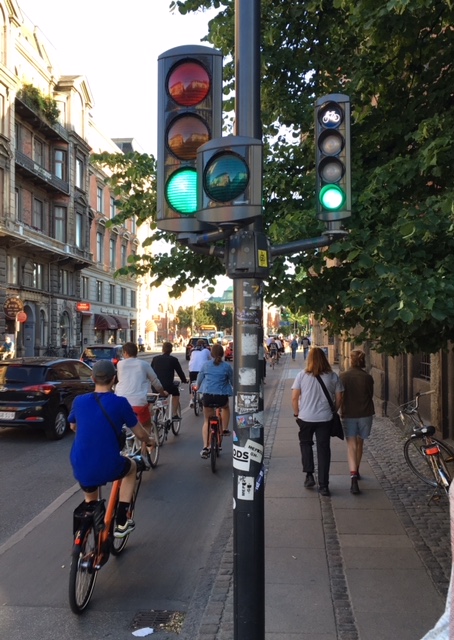
Innovations in Copenhagen include the green wave at different times of the day and to give cyclists a head start.
Traffic signals are timed to allow maximum flow of cyclist through in peak flow. Seperate signals give cyclists a head start to improve visibility and safety when drivers are wanting to turn across the bike lane at intersections.
Bike parking
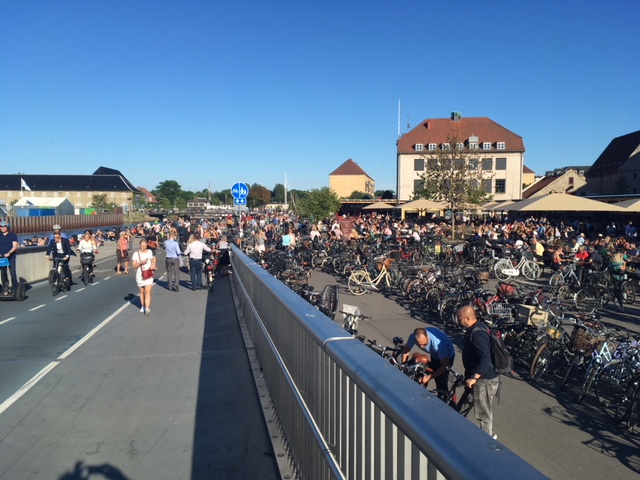
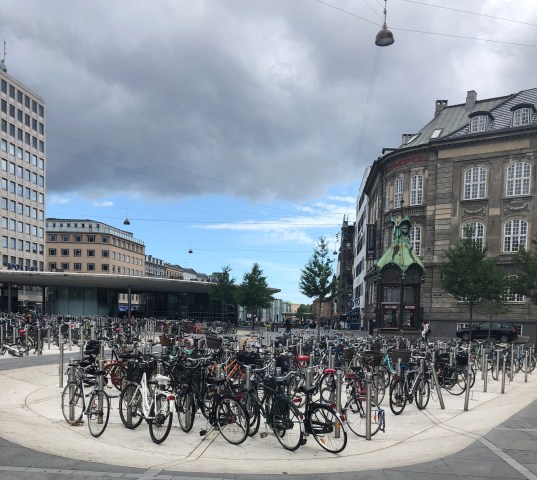
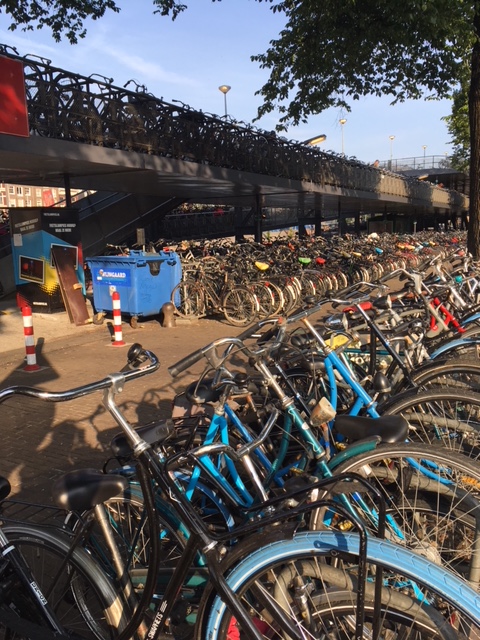
As cycling become more popular finding space becomes and issue. It’s important that bike parking provision is done right. Often architects don’t consider it until it’s an after thought. It must be safe, close to where people are heading (near the front door not hidden around the back). For longer stays bike parking should be under cover and secure.
Bike parking outside a Copenhagen metro stationParking is such a premium in parts of Amsterdam that they have parked a barge in the canal to provide extra bike parksAt Amsterdam Central Railway Station they have added a multi story bike park
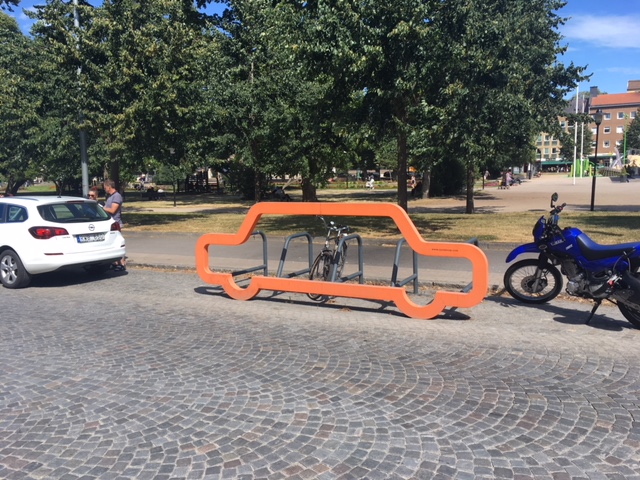
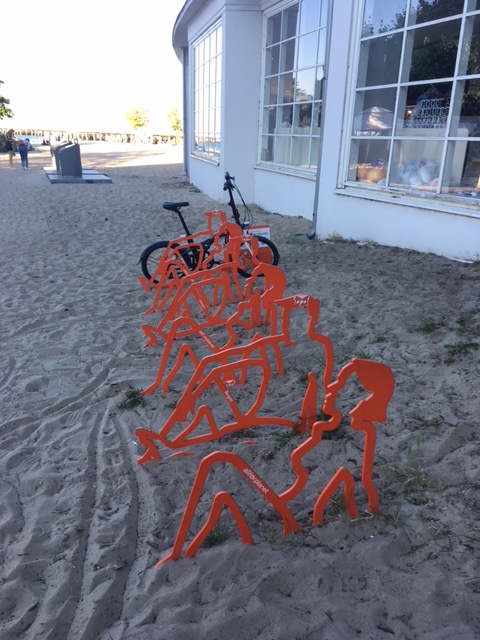
Some novelty bike racks
Karlskrona in Sweden
At the back of the beach – Sopot Poland
Emerging trends
Increasing the use of bike share for long distance trips, in association with light rail or buses.
There is also a debate about bike share and whether to have docking stations. While we’ve been away Canberra is going to trial bike sharing without docking stations. It’s interesting to look at the lessons from European cities.
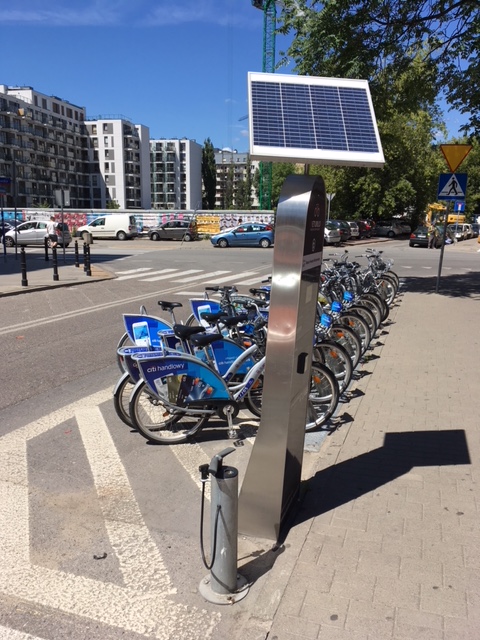
Bike share schemes are really popular in cities across Europe, many cities are opting for docking stations. This makes it clearer to people where the bikes are and reduces the negative reaction that bikes are just left all over the city. This docking station in Warsaw includes a solar powered bike pump.
The crazy motor scooter rule
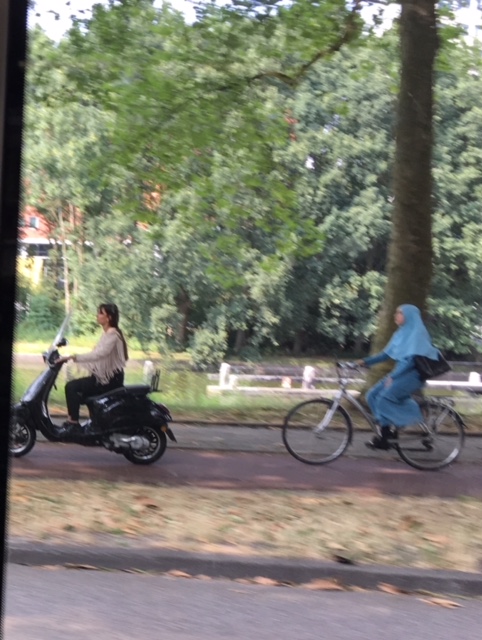
In both Amsterdam and Copenhagen there is a crazy rule that allows motor scooters up to a certain size to also use the bike path, which seems to go completly against the idea of making cyclists seem safe. There will be a growing issue with electric bikes
I’m looking forward to viewing cycling in Canberra with a fresh set of eyes following the Masterclass and observations from other cities.
Just as I post this my brother-in-law (who has completed a tour of Scotland and Northern England on his bike) has posted a study from the University of Sydney that finds that those people who do moderate cycling about 10 hours a week enjoy the greatest reduction in chronic disease and the highest odds of both optimal mental and physical health.
2 thoughts on “Copenhagenize Masterclass on bicycle friendly urban places.”
All very interesting! How many OLD people on bikes .Are three wheelers seen? I can see things improving for bike riders in Canberra when you return. It shouldn’t be too hard. GB
N
Well done Alex, the photo of Canberra cyclists I sent to Mikael a few years back. It from the film National Capital 1945. It was also in the book by Barbara Malpass Cycling in Canberra – A history of cycling in Canberra & Region. Would be good if Transport Canberra and the Minister could do a masterclass as well, because they are not listenening to cycle friendly city advocates like myself.








 Parental Gap-Year
All very interesting! How many OLD people on bikes .Are three wheelers seen? I can see things improving for bike riders in Canberra when you return. It shouldn’t be too hard. GB
N
LikeLike
Well done Alex, the photo of Canberra cyclists I sent to Mikael a few years back. It from the film National Capital 1945. It was also in the book by Barbara Malpass Cycling in Canberra – A history of cycling in Canberra & Region. Would be good if Transport Canberra and the Minister could do a masterclass as well, because they are not listenening to cycle friendly city advocates like myself.
LikeLike